
Lafayette County Court Records After Arrest
After a Lafayette County arrest, the first public trail is usually a booking record held by the Lafayette County Jail / Lafayette County Sheriff's Office. That entry may show the arresting agency, the booking charge, bond, release status, and whether a hold exists. It is not the same as the court record. Court records after a jail arrest start when the prosecutor files a complaint or information, or when another charging path opens a criminal case.
Lafayette County is part of Arkansas's Eighth Judicial District South. The official prosecutor page for that district says it includes Miller and Lafayette Counties and names Connie Mitchell as Prosecuting Attorney. It also lists David Freeze as Deputy Prosecutor and Lori Ellison as Legal Assistant / Victim Witness Coordinator for the Lafayette County office. That office reviews law-enforcement reports and decides what charges to file. For custody and booking facts, use Lafayette County jail inmate records. For booking photos, use the Lafayette County jail mugshots page. For filed charges, hearings, warrants, and dispositions, use the court case record.
Local court contact: Lafayette County Circuit Clerk Dana Phillips, 3rd & Spruce Streets, Lewisville, AR 71845, 870-921-4878. Ask whether a new filing is available before making a trip.
Find Lafayette County Court Records
The main public court search path is Search ARCourts. Research captured the public landing page and the "Search by... Participants" option, but the live interface did not expose every field through static text. In practice, start with the defendant name, then use a case number if one appears on jail, bond, warrant, or clerk paperwork. If county or court filters are visible in the live search, narrow the search to Lafayette County or the right court level.
The Search ARCourts public case-search page is the official screen to check before calling the clerk.
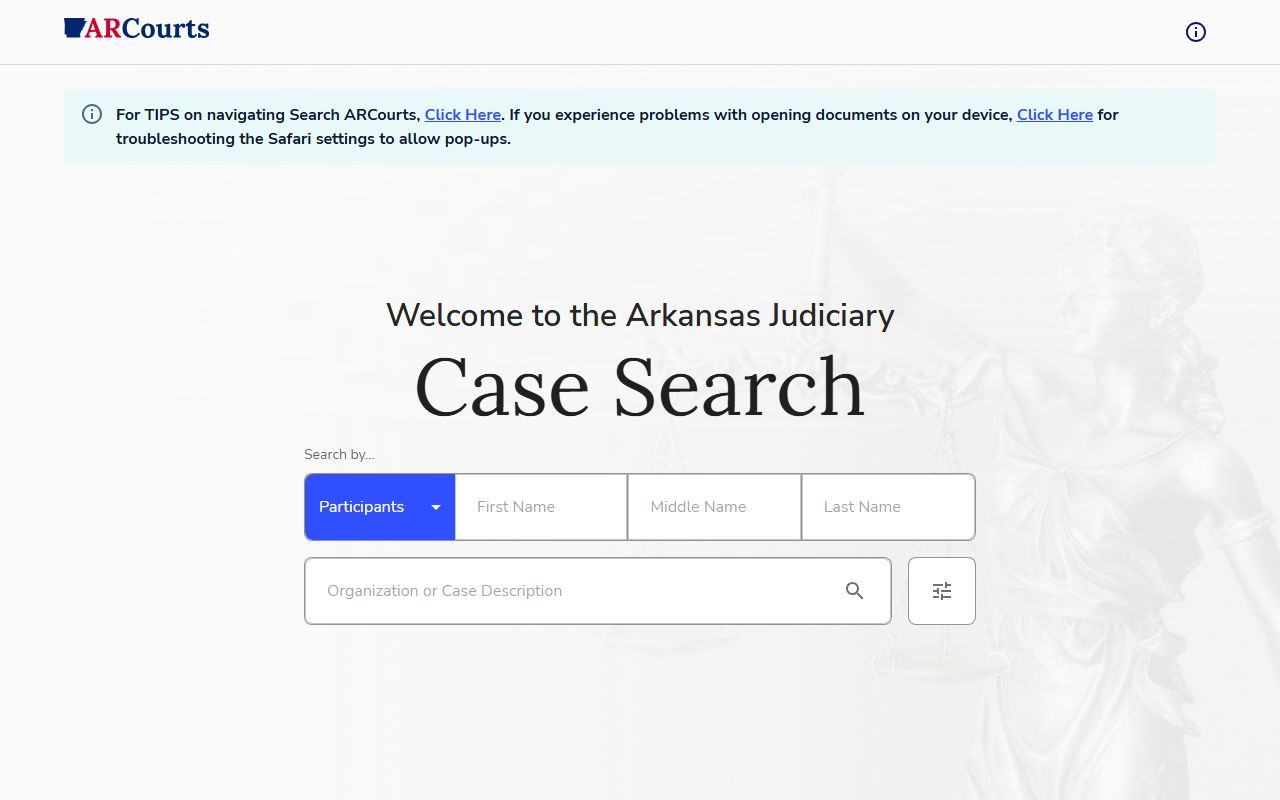
Use the case-search screen for the formal court record. A same-day booking may not have a case yet, so a blank result does not prove that no Lafayette County arrest occurred.
| Search Field | Type | How to Use It |
|---|---|---|
| Search by Participants | Tab or option | Use for defendant-name searches when the case number is not known. |
| Case number | Text field if shown | Use the number from a court notice, bond paper, warrant, or clerk receipt. |
| Defendant name | Text field if shown | Search full legal name and try spelling variants for common names. |
| County or court filter | Dropdown if shown | Select Lafayette County, district court, or circuit court when the interface permits it. |
Lafayette County Arrest to Court Record
The basic path is arrest, booking, first appearance, prosecutor review, filing, and court case tracking. A deputy, city officer, state trooper, federal officer, or another agency may make the arrest. The jail records the intake facts. Then the prosecutor decides whether to file the same charge, add counts, reduce a charge, dismiss a count, or pursue a different charge after reviewing reports.
- Gather the booking facts: full name, date of birth if known, arrest date, arresting agency, and any charge listed by the jail.
- Search ARCourts by participant name. Use a case number if the jail, bond paper, or court notice gives one.
- Check district court for misdemeanors, traffic matters, ordinance cases, and preliminary felony proceedings.
- Check circuit court for felony cases and other criminal matters within Arkansas circuit-court jurisdiction.
- Compare the court-filed charge list with the jail booking charge. Treat the court-filed list as the case record.
The Circuit Clerk can help locate files that are older, newly filed, or not clear in online search. The Arkansas Judiciary circuit clerk directory lists Dana Phillips for Lafayette County.
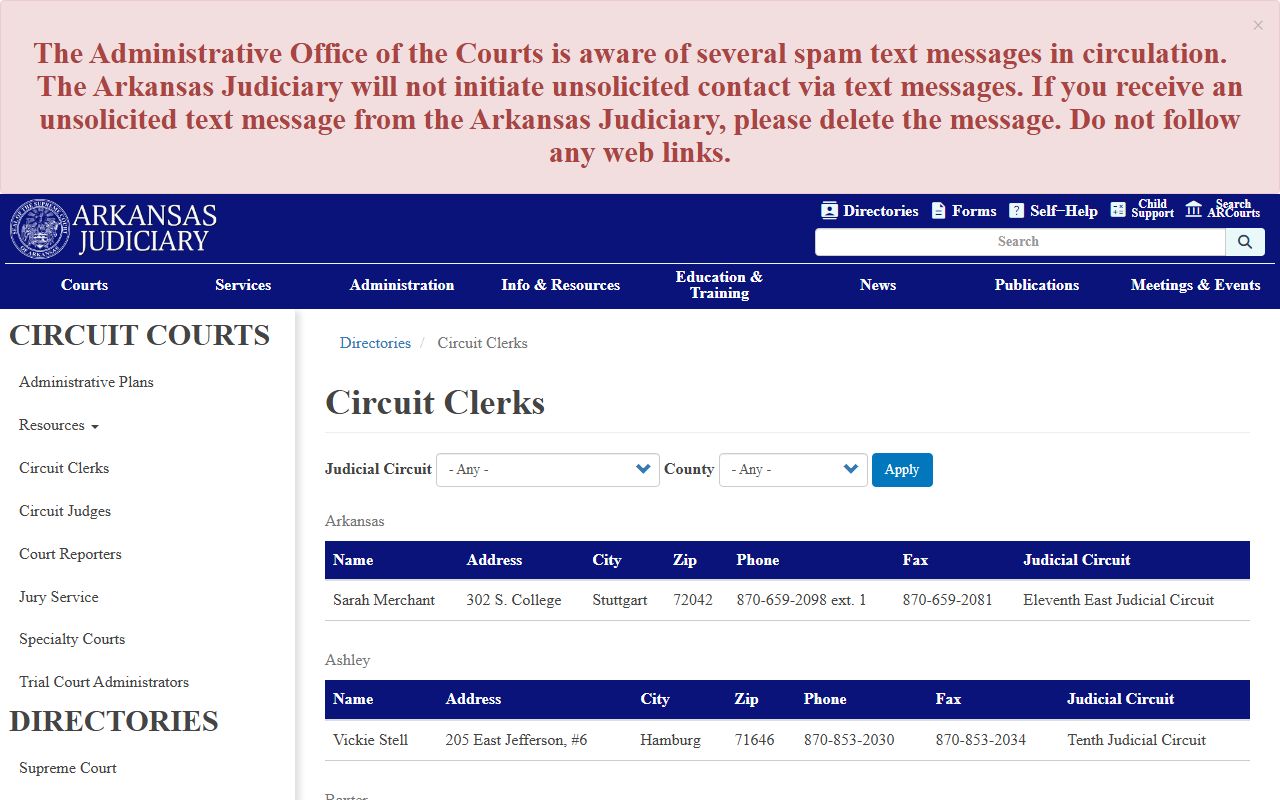
The clerk directory matters because certified copies, sealed-file questions, and older criminal files often require clerk help rather than only a web search.
District and Circuit Court Records
Arkansas district courts handle misdemeanors, traffic cases, ordinance violations, preliminary felony matters, small claims, and other smaller civil matters. That makes district court important after a Lafayette County jail arrest for lower-level charges and for early felony steps. A first appearance or bond issue may show there before a case moves or develops into a circuit-court matter.
Arkansas circuit courts are general-jurisdiction courts. The Arkansas Judiciary describes circuit courts as having criminal, civil, probate, domestic-relations, and juvenile divisions. For Lafayette County court records after a jail arrest involving a felony, a circuit-court record is usually the main formal case record after the prosecutor files the charge. The same arrest can also involve more than one court if traffic, warrant, misdemeanor, and felony issues overlap.
| Court Level | Common Criminal Use | Record Point |
|---|---|---|
| District court | Misdemeanors, traffic, ordinance cases, and preliminary felony issues. | Check early dates, bond, lower-level cases, and bench-warrant events. |
| Circuit court | Felonies and other general-jurisdiction criminal matters. | Check filed charges, amended charges, hearings, dispositions, and sentencing orders. |
Lafayette County Charging Documents
A booking charge is an intake label. A charging document is the legal paper that starts or defines the court case. The Eighth Judicial District South prosecutor may file a complaint or information, and a grand-jury indictment is possible in serious matters. The exact term matters because a court record after an arrest may not match the first jail entry.
| Document | Who Uses It | What It Means |
|---|---|---|
| Complaint | Officer or prosecutor, depending on case path. | Alleges an offense and can begin a criminal case or support an early court step. |
| Information | Prosecutor. | Formal prosecutor-filed charge, often important in felony cases. |
| Indictment | Grand jury. | Grand-jury accusation used when that charging path is pursued. |
Victims and witnesses may see another side of the same case. The Eighth Judicial District South prosecutor page describes victim-witness services such as criminal-process information, case-development notices, court accompaniment, restitution and property recovery help, referrals, crime victim reparations, and VINE or Arkansas DOC notification support. Those services do not replace Search ARCourts or clerk records, but they explain why case status and custody status may be tracked through different channels.
Lafayette County Charge Status
Charges can change after a Lafayette County jail arrest. A prosecutor may amend a count, reduce it, dismiss it, add another count, or enter nolle prosequi. A judge may issue a warrant after a missed court date or recall a warrant after the person appears. Read each docket event with the date attached because old status text can sit next to a newer outcome.
| Status | Plain Meaning |
|---|---|
| Pending | The charge has been filed and no final outcome is shown yet. |
| Amended | The prosecutor or court changed the charge wording, count, code, or level. |
| Reduced | The charge was lowered to a lesser offense or lower severity. |
| Dismissed | The charge ended without a conviction on that count. |
| Nolle prosequi | The prosecutor declined or ended prosecution of the charge. |
| Warrant issued | The court ordered an arrest, often after failure to appear. |
Bond and Warrant Records
Bond is both a jail question and a court question. For a person still held in the Lafayette County jail, the sheriff's office may be the fastest source for whether bond has been set and whether another hold blocks release. Public listings commonly show 870-921-4252 for the sheriff's office, while the Association of Arkansas Counties displays a malformed 870-921-4258-style listing. Verify the current jail or records line before travel.
Court records may show a bond order, a later bond change, a bench warrant, or a warrant recall. Local bond payment methods, hours, and online options were not published in the official sources reviewed, so confirm the process with the jail, district court, or Circuit Clerk. Ask whether the bond is cash, surety, property, personal recognizance, or no-bond. Also ask whether a DOC, probation, parole, out-of-county, federal, or ICE hold remains after local bond is posted.
Charges and Convictions Compared
An arrest and a charge are not convictions. A Lafayette County court record after an arrest can show accusations, bond terms, dates, and pending events before any final finding. A conviction appears only after a guilty plea, accepted plea, verdict, or another final disposition that legally resolves guilt.
| Point | Charge | Conviction |
|---|---|---|
| Stage | Filed accusation in a pending or unresolved case. | Final guilty finding, plea, or accepted judgment. |
| Proof | Based on probable cause or prosecutor filing choice. | Requires plea, verdict, or other final legal outcome. |
| Can change | May be amended, reduced, or dismissed. | Changes only through later court action, appeal, or sealing process. |
| How to verify | Read the charge list and docket events. | Read the disposition, plea, verdict, and sentencing entries. |
Sealed Lafayette County Records
Arkansas FOIA, including Ark. Code Ann. § 25-19-105 and the public-record definitions in § 25-19-103, provides the open-records framework for records held by public agencies unless an exemption applies. Court records, sheriff records, and booking records can still be restricted when a law, order, juvenile rule, investigation exemption, or privacy protection applies. Arkansas also has a criminal-record sealing framework, cited in the research as Ark. Code Ann. § 16-90-1401 et seq.
| Term | Effect | Who to Ask |
|---|---|---|
| Sealed | Public access is limited by court process or law, but some official access can remain. | Circuit Clerk or the court that entered the order. |
| Expunged | Often used by the public to mean cleared, though Arkansas commonly frames relief through sealing. | Court clerk or attorney for the exact Arkansas remedy. |
| Juvenile restricted | Youth records may be outside ordinary public access. | Court clerk, with proof of authority if required. |
| Active investigation | Some law-enforcement material may be withheld while the case is active. | Agency holding the record, with the cited exemption requested. |
For a denied record request, ask the agency to identify the legal basis for withholding. For a sealed or expungement question, verify with the court file. The sheriff can address jail records, but the clerk is the better source for court orders that change public access.
Arkansas Record Limits
Several Arkansas statutes shape court records after a Lafayette County jail arrest. Ark. Code Ann. § 25-19-105 governs inspection and copying of public records. Ark. Code Ann. § 12-41-502 connects the county sheriff to custody of prisoners. Ark. Code Ann. § 16-84-101 et seq. frames bail and bond concepts. Ark. Code Ann. § 12-12-1001 et seq. covers Arkansas Crime Information Center and criminal-history dissemination, which is separate from a jail booking or court docket search.
Important: Do not use casual court, jail, or inmate lookup results for employment, housing, credit, insurance, or other FCRA-covered screening decisions.